Biti il' ne biti: Difference between revisions
(I needed a rescan of biti il ne biti for a video. Ended up going the whole nine yards and thought to just get on with making the article.) |
Generacide (talk | contribs) m (Reverted edits by Yarnmisery (talk) to last revision by Ziwi) Tag: Rollback |
||
| (4 intermediate revisions by 3 users not shown) | |||
| Line 20: | Line 20: | ||
In 1999, the Kosovo War would once again draw attention to Yugoslavia, four years after the end of the Bosnian War. Upon the news of the Račak incident and before a proper investigation could take place, America initiated a bombing campaign on Belgrade through NATO. At night, many had to evacuate to bomb shelters and turn off the lights so as to not make themselves a target.<ref>Werth, Matthias (Director). 1 August 2000. "Es begann mit einer Lüge". WDR Fernsehen.</ref> | In 1999, the Kosovo War would once again draw attention to Yugoslavia, four years after the end of the Bosnian War. Upon the news of the Račak incident and before a proper investigation could take place, America initiated a bombing campaign on Belgrade through NATO. At night, many had to evacuate to bomb shelters and turn off the lights so as to not make themselves a target.<ref>Werth, Matthias (Director). 1 August 2000. "Es begann mit einer Lüge". WDR Fernsehen.</ref> | ||
The album was recorded April 29-30th in the middle of the night | The album was recorded April 29-30th in the middle of the night as reflected by the full moon on the cover. It is the first time in six years where Baja worked with Cale on a solo project since ''[[Živeće ovaj narod]]''. The last track, "Ne diraj u srce" is a cover of the Neđo Kostić song of the same name from the album, ''[[Nije lako Srbin biti]]''. The song "[[Pravoslavac (Biti il' ne biti)|Pravoslavac]]" is not a reworked version of "[[Pravoslavac]]" from 1994's ''[[Pobediće istina]]''. Instead it is an entirely new and original track, which causes some confusion between the two in modern times. Unlike previous conflict-related albums where it had elements of disco and folk, this album is purely folk with his work being closer to the 1992 album, ''[[Stan'te paše i ustaše]]''. | ||
Some songs are reminiscent of other songs from Baja's previous work: "Ne daj se narode moj" is sung similarly to "Nebo je plakalo s nama", "Kosovo je naša duša" and "Diraju nas ponovo" are similar to "[[Pevaj Srbijo]]" with the former being similar instrumentally and the | Some songs are reminiscent of other songs from Baja's previous work: "Ne daj se narode moj" is sung similarly to "Nebo je plakalo s nama", "Kosovo je naša duša" and "Diraju nas ponovo" are similar to "[[Pevaj Srbijo]]" with the former being similar instrumentally and the latter being similar in the way it is sung, "Kosovo je Srpsko" is sung similarly to the ''[[Igraju se delije]]'' song, "[[Soko]]", and "Bog sa neba gleda" is musically similar to "[[Stan'te paše i ustaše (Song)|Stan'te paše i ustaše]]" with the chorus being sung in a similar tune to the chorus of "[[Dejton-Ohajo]]". While "Pravoslavac" uses elements from another work, it is not from Baja's previous works but rather Cale's. The instrumental breaks in-between choruses and verses were initially used in the 1994 album, ''[[Dosta mi je rata]]'', specifically riffs from "Moja deda ratnik bio" and "Ja bogotaš nisam". | ||
==Release== | ==Release== | ||
''Biti il' ne biti'' was released some time in 1999 on both CD and cassette in the midst of the bombing campaign. The songs "Tesla", " Kosovo je naša duša", and "Bog sa neba gleda" are featured in the [[Target Produckija]] compilation, ''[[Jugoslavija u srcu 2]]''. It is unknown if Baja had any involvement with the compilation. | ''Biti il' ne biti'' was released some time in 1999 on both CD and cassette in the midst of the bombing campaign. The songs "Tesla", " Kosovo je naša duša", and "Bog sa neba gleda" are featured in the [[Target Produckija]] compilation, ''[[Jugoslavija u srcu 2]]''. It is unknown if Baja had any involvement with the compilation. | ||
There | There are two known releases of the cassette version: a clear shell with pad-printed white text, and a clear shell with pad-printed white text and a black plastic sheet. Despite these variants looking identical, the version with the black plastic sheet has better audio quality than the clear shell. Some versions of the cassette release have "Ne diraj u srce" two seconds slower whereas the rest of the tape is at normal speed. | ||
There are two known versions of the CD version of ''Biti il' ne biti'': a version produced in-house for typical CD jewel cases and a version released by Comp Line d.o.o. with alternate art to accommodate for a slim keep case. Both releases have peaking on the last track, "Ne diraj u | There are two known versions of the CD version of ''Biti il' ne biti'': a version produced in-house for typical CD jewel cases and a version released by Comp Line d.o.o. with alternate art to accommodate for a slim keep case. Both releases have peaking on the last track, "Ne diraj u srce". | ||
==Track listing== | ==Track listing== | ||
{{Track listing | All songs written and composed by БАЈА МАЛИ КНИНЏА except where noted.{{Track listing | ||
| headline = Side A | | headline = Side A | ||
| title1 = [[Tesla|Тесла]] | | title1 = [[Tesla|Тесла]] | ||
| Line 77: | Line 77: | ||
====Miscellaneous==== | ====Miscellaneous==== | ||
"СРПСКИ ПОНОС И СЛОБОДА | "СРПСКИ ПОНОС И СЛОБОДА | ||
НИЈЕ РОБА ДА СЕ ПРОДА!" | НИЈЕ РОБА ДА СЕ ПРОДА!" | ||
| Line 108: | Line 109: | ||
*Excellent audio quality | *Excellent audio quality | ||
*Alternate cover | *Alternate cover | ||
*Uses a | *Uses a keep case instead of a standard CD jewel case | ||
*Signature embossed stamp | *Signature embossed stamp | ||
| align = none | | align = none | ||
Latest revision as of 04:18, 25 April 2026
| Бити ил' не бити | ||||
|---|---|---|---|---|
 | ||||
| Studio album by | ||||
| Released | 1999 | |||
| Genre | Novokompovana | |||
| Length | 22:35 | |||
| Label | Renome | |||
| Баја Мали Книнџа chronology | ||||
| ||||
Biti il' ne biti (Serbian Cyrillic: Бити ил' не бити, lit. "To Be or Not To Be") is the thirteenth studio album by prominent Serb war singer Baja Mali Knindža. It is the last album Baja would release on an active conflict. At just over twenty-two minutes, this is the shortest war-related album Baja has released to date.
Background
In 1999, the Kosovo War would once again draw attention to Yugoslavia, four years after the end of the Bosnian War. Upon the news of the Račak incident and before a proper investigation could take place, America initiated a bombing campaign on Belgrade through NATO. At night, many had to evacuate to bomb shelters and turn off the lights so as to not make themselves a target.[1]
The album was recorded April 29-30th in the middle of the night as reflected by the full moon on the cover. It is the first time in six years where Baja worked with Cale on a solo project since Živeće ovaj narod. The last track, "Ne diraj u srce" is a cover of the Neđo Kostić song of the same name from the album, Nije lako Srbin biti. The song "Pravoslavac" is not a reworked version of "Pravoslavac" from 1994's Pobediće istina. Instead it is an entirely new and original track, which causes some confusion between the two in modern times. Unlike previous conflict-related albums where it had elements of disco and folk, this album is purely folk with his work being closer to the 1992 album, Stan'te paše i ustaše.
Some songs are reminiscent of other songs from Baja's previous work: "Ne daj se narode moj" is sung similarly to "Nebo je plakalo s nama", "Kosovo je naša duša" and "Diraju nas ponovo" are similar to "Pevaj Srbijo" with the former being similar instrumentally and the latter being similar in the way it is sung, "Kosovo je Srpsko" is sung similarly to the Igraju se delije song, "Soko", and "Bog sa neba gleda" is musically similar to "Stan'te paše i ustaše" with the chorus being sung in a similar tune to the chorus of "Dejton-Ohajo". While "Pravoslavac" uses elements from another work, it is not from Baja's previous works but rather Cale's. The instrumental breaks in-between choruses and verses were initially used in the 1994 album, Dosta mi je rata, specifically riffs from "Moja deda ratnik bio" and "Ja bogotaš nisam".
Release
Biti il' ne biti was released some time in 1999 on both CD and cassette in the midst of the bombing campaign. The songs "Tesla", " Kosovo je naša duša", and "Bog sa neba gleda" are featured in the Target Produckija compilation, Jugoslavija u srcu 2. It is unknown if Baja had any involvement with the compilation.
There are two known releases of the cassette version: a clear shell with pad-printed white text, and a clear shell with pad-printed white text and a black plastic sheet. Despite these variants looking identical, the version with the black plastic sheet has better audio quality than the clear shell. Some versions of the cassette release have "Ne diraj u srce" two seconds slower whereas the rest of the tape is at normal speed.
There are two known versions of the CD version of Biti il' ne biti: a version produced in-house for typical CD jewel cases and a version released by Comp Line d.o.o. with alternate art to accommodate for a slim keep case. Both releases have peaking on the last track, "Ne diraj u srce".
Track listing
All songs written and composed by БАЈА МАЛИ КНИНЏА except where noted.
| No. | Title | Length |
|---|---|---|
| 1. | "Тесла" | 2:21 |
| 2. | "Православац" | 2:42 |
| 3. | "Не дај се народе мој" | 3:18 |
| 4. | "Косово је наша душа" | 2:44 |
| No. | Title | Lyrics | Music | Length |
|---|---|---|---|---|
| 1. | "Дирају нас поново" | 2:34 | ||
| 2. | "Бог са неба гледа" | 2:55 | ||
| 3. | "Косово је Српско" | 2:55 | ||
| 4. | "Не дирај у срце" | Неђо Костић | Милош Миличић | 3:07 |
| Total length: | 22:35 | |||
Personnel
Writing
- БАЈА МАЛИ КНИНЏА - Музика и текстови
- НЕЂО КОСТИЋ- Текст (Б4)
- МИЛОШ МИЛИЧИЋ- Музика (Б4)
- СЛАВКО МИТРОВИЋ ЦАЛЕ- Аранжмани
- Славко Митровић Цалета- Оркестар
Production
- "РАВНА ГОРА"- Студио
- Муња- Фото
- LITHO ART studio - Београд- Дизајн и штампа
- РЕНОМЕ- Продукција
- Предраг Дреугић Преша- Музички уредник
- Синиша Кајмаковић- Директор
Miscellaneous
"СРПСКИ ПОНОС И СЛОБОДА
НИЈЕ РОБА ДА СЕ ПРОДА!"
Баја
Морална подршка:
грил "МАТИЈАШ" - Земун Шасмо, Јово и Калаба Јово
Variants


- Signature embossed Renome stamp
- Excellent audio quality
- Last track slightly slower


Gallery
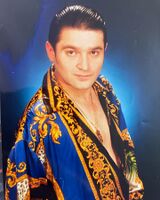
Another image from one of the photoshoots used.

References
- ↑ Werth, Matthias (Director). 1 August 2000. "Es begann mit einer Lüge". WDR Fernsehen.